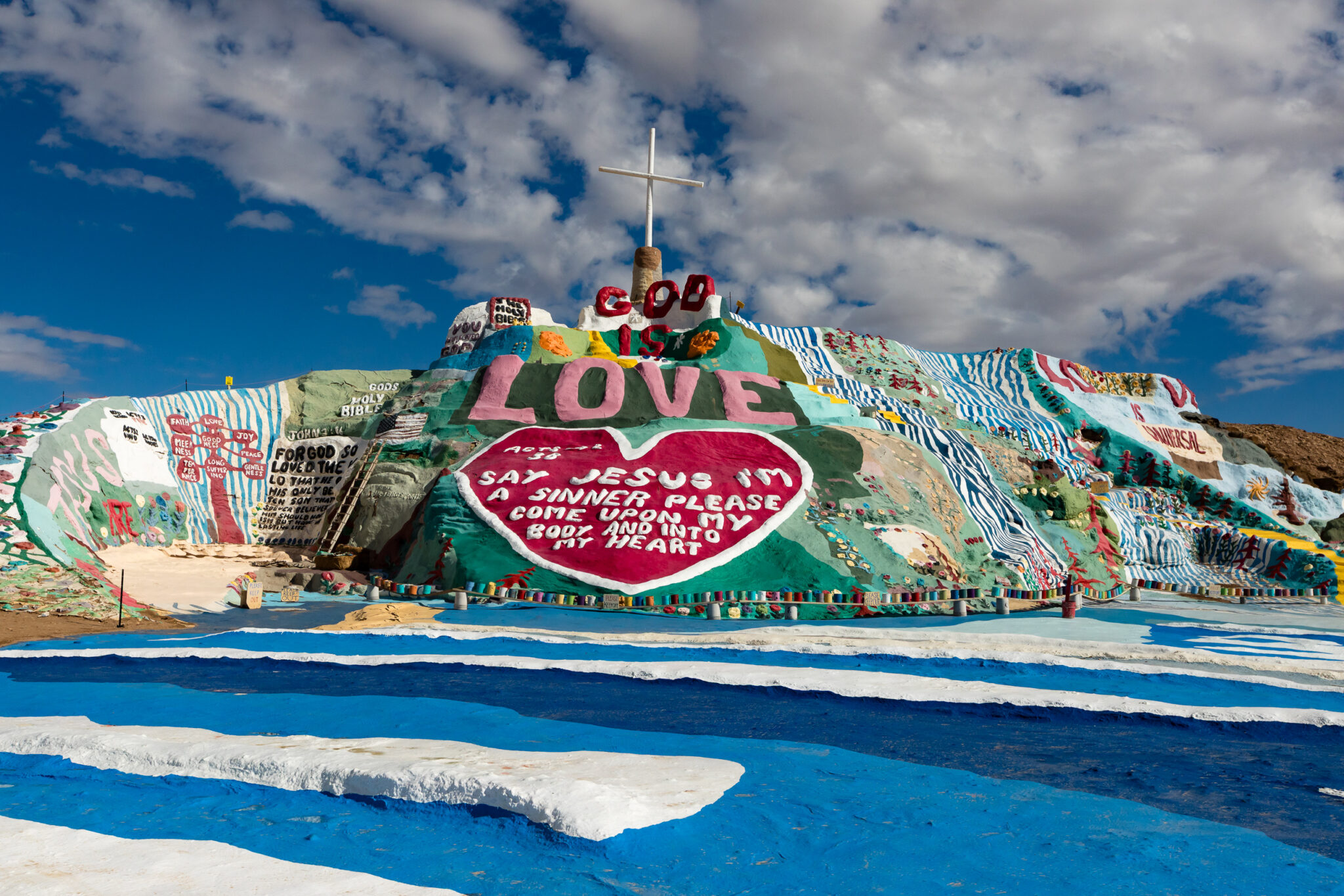
“There’s going to be a worldwide love story coming down, universal. Love’s going to come down and it’s going to stomp all over hate. Hate is a losing proposition – it’s not as big as love. Total love is going to come down, and I see it coming. God! I see it coming!” – Leonard Knight
Driving through Niland, a drab town becoming ghostly with no one in sight and boarded up decaying buildings, I was both eager to experience Salvation Mountain and a little nervous about visiting the off-grid alternate lifestyle community of Slab City.
Slab City was established in the early 60s by people escaping brutal winters, confining societal norms, and economic hardship. The community settled on the abandoned foundations of Camp Dunlap, a former World War II military base in the Sonoran Desert between the Salton Sea on the east and the Chocolate Mountains Aerial Gunnery Range on the west. Despite not having laws, running water, sewage, electricity, or trash collection, the community continues to attract artists, retirees, drifters, and others seeking an alternative lifestyle. The small summer population of 150 residents swells to about 4,000 in the mild winter months. Drug addiction is prevalent, driving theft and reports of occasional violence. For some, living in the squatter settlement may be more out of necessity than choice.
With my tires rumbling over the slowly deteriorating road into Slab City, I first sighted Salvation Mountain. From a distance, it appears to be a huge pile of brightly colored licorice allsorts set against the pale, dusty desert landscape. This is where legend says Leonard Knight’s truck broke down in the mid-80s. Deciding to stop there, he erected a cross marking the genesis of what was to become Salvation Mountain. The 50-year-old Leonard dedicated his remaining 30 years to building his vision, working every day and sleeping in his truck at the base of Salvation Mountain. His creation is a wonder, a fascinating sculpture attracting pilgrims and the curious from around the world.
Before settling at Salvation Mountain, Leonard struggled to find purpose1. Friends speculated he may have had a form of Asperger’s Syndrome causing him to feel overwhelmed in social situations. After serving in the Korean War, he returned to Vermont, drifted between odd jobs and drank heavily. At age 35, his sister implored him to join her church. Escaping to his truck he found himself repeating the Sinner’s prayer with tears streaming down his face. He recalled this moment as the start of his “love story” with God. He decorated his truck with religious messages to demonstrate his love but was dissatisfied with local churches, believing they strayed from the key message that “God is Love”. After seeing people’s fascination with a hot-air balloon in flight, he realized his life’s purpose was to create a project to spread the message of God, and a balloon was the perfect medium. Unable to raise funds to buy a balloon, he moved to Nebraska and lived in a trailer alongside the Platte River, where he spent most of the 1970s sewing scraps of materials into a 100 foot diameter balloon. He could never get the balloon to fly, and eventually the materials rotted beyond repair. With this bitter setback, Leonard travelled further southwest, finally ending his wandering on a low hill at the entrance to Slab City in 1984.
This is where, by hand, he began building a monument of concrete and paint to God. Five years later, a heavy 1989 rainstorm caused the structure to crack and collapse. Undeterred, Leonard re-built his project using mud and straw to create the structure over a base of hay bales, old tires, and discarded building materials he found in the Niland landfill. He then coated the monument with brightly colored paint, which both decorates and protects the adobe structure.
I visited Salvation Mountain on a warm, windless Monday in January. The monument is much larger than I expected, and entranced by the bright colors, I raced around the sculpture wanting, in vain, to quickly absorb and understand the work. Noticing the other visitors were almost whispering to each other, I realized it is a quiet contemplative place, much like a church or temple, a sacred site. I slowed down to appreciate the monument produced by one man working every day and sleeping in the back of his truck for nearly 30 years to fulfill his vision.
In creating Salvation Mountain, Leonard found his life purpose and made the best use of his time on earth.
Leonard passed away in 2014, at age 83. A few years earlier he had been forced to leave Slab City because of health issues, triggering concern that the repair-needy Salvation Mountain would not survive without him. Despite reports of damage, when I visited the sculpture, it was in good condition with ongoing repair work and the chemical scent of fresh paint in the air. The Folk Art Society of America recognized Salvation Mountain in 2000 as a site worthy of protection. Salvation Mountain is looked after by a nonprofit organization, which is raising funds to buy the land on which it is built to secure its long-term survival. The desert is a harsh environment, and I hope there are people to care for the sculpture with a passion similar to the spirit that created the monument.
Slab City is just too strange, too apocalyptic, and altogether too intriguing for me not to visit again. When I do, I hope to find Salvation Mountain lovingly cared for and continuing to entice the inquisitive and the spiritual.
“I’m thrilled about people’s beautiful attitude, because people really seem to like the mountain a lot. Maybe they’re just saying it to make me feel good, I don’t know. But if that’s why they’re saying it, it’s working. And I want to thank ‘em for making me feel good.” – Leonard Knight


